Sabray's Postcard
Music in a Venetian Gondola

The three young ladies on this card, finely dressed and enjoying music in a gondola, glided through the postal system from Alto Pass to Springerton, Illinois in May of 1908. The sender was Sabray Catherine Underwood, née Barrow and the recipients were her brother-in-law and sister, Noah and Nancy Miriam (Barrow) Carter.
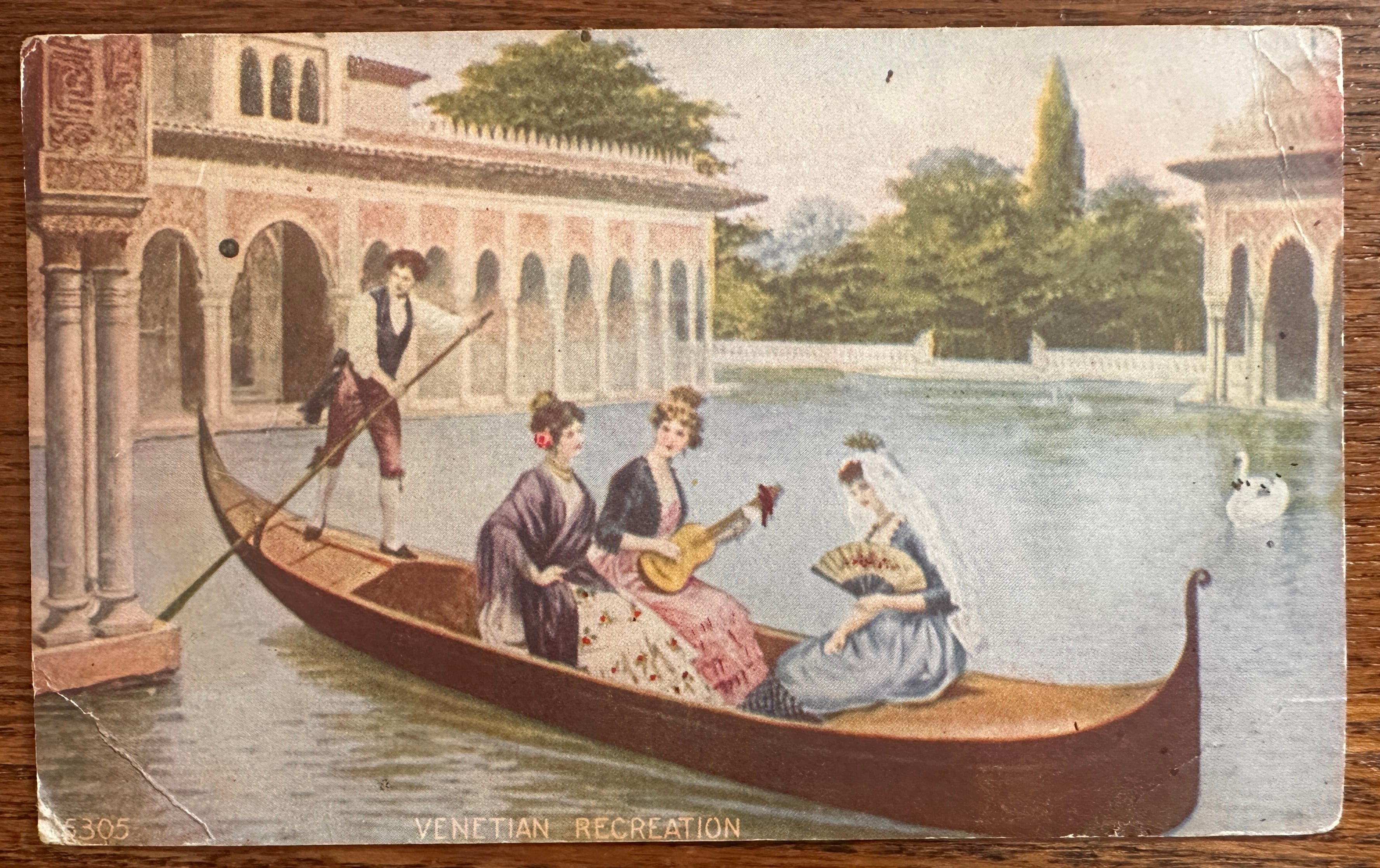
As with many of the postcards I find, no street address is given on the card, only the name, city, and state, with the county noted at the bottom. For the photo of the message on the back, I adjusted the contrast, clarity, and black point to bring out the fading pencilled writing. Transcription is below; I’ve added punctuation to make it easier to read.
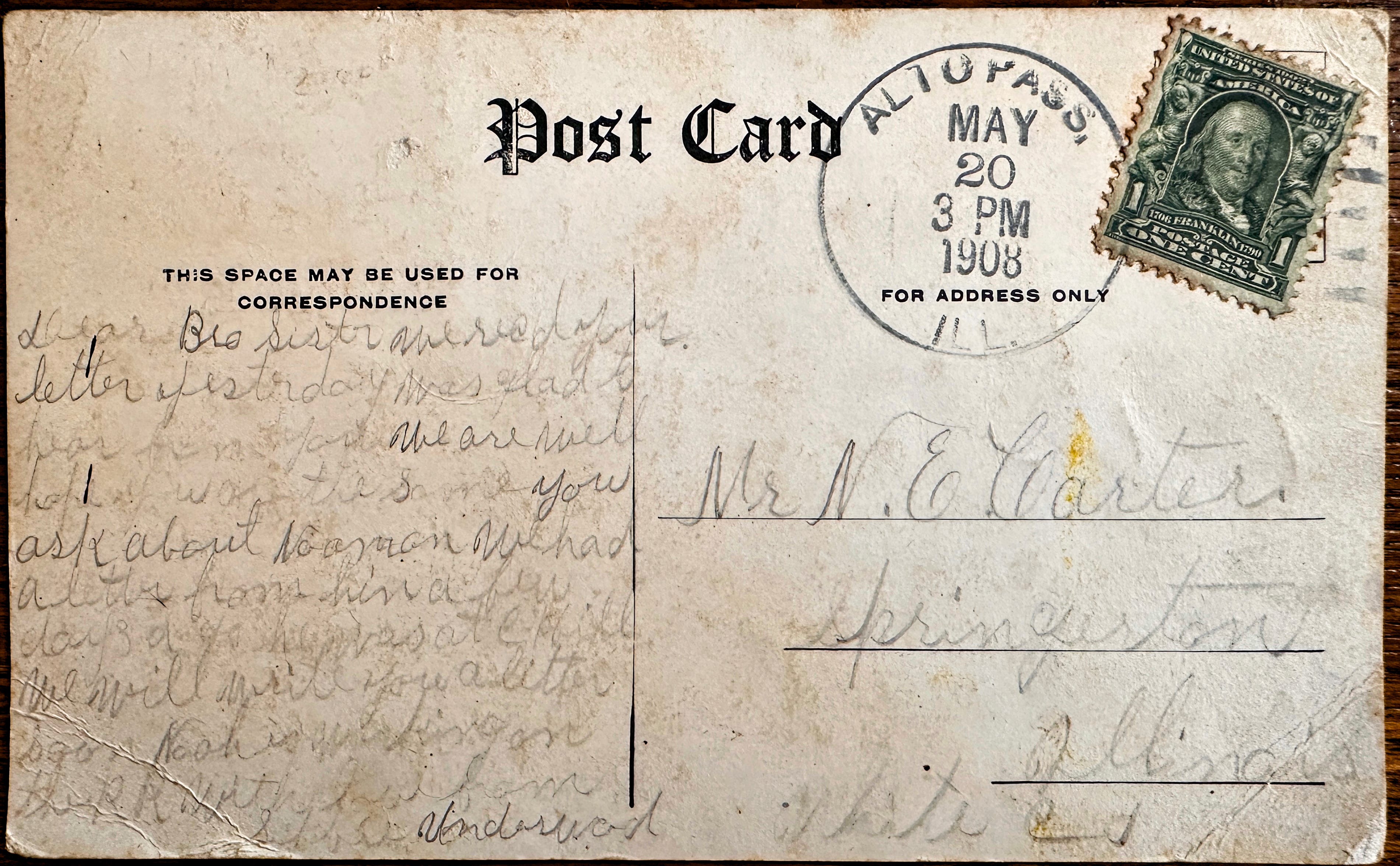
Dear Bro Sister. We read your letter yesterday. Was glad to hear from you. We are well, hope you are the same. You ask about Naamon, we had a letter from him a few days ago. He was at C Hill. We will write you a letter soon. Noah is working on the RR. With love from Sabbie Underwood
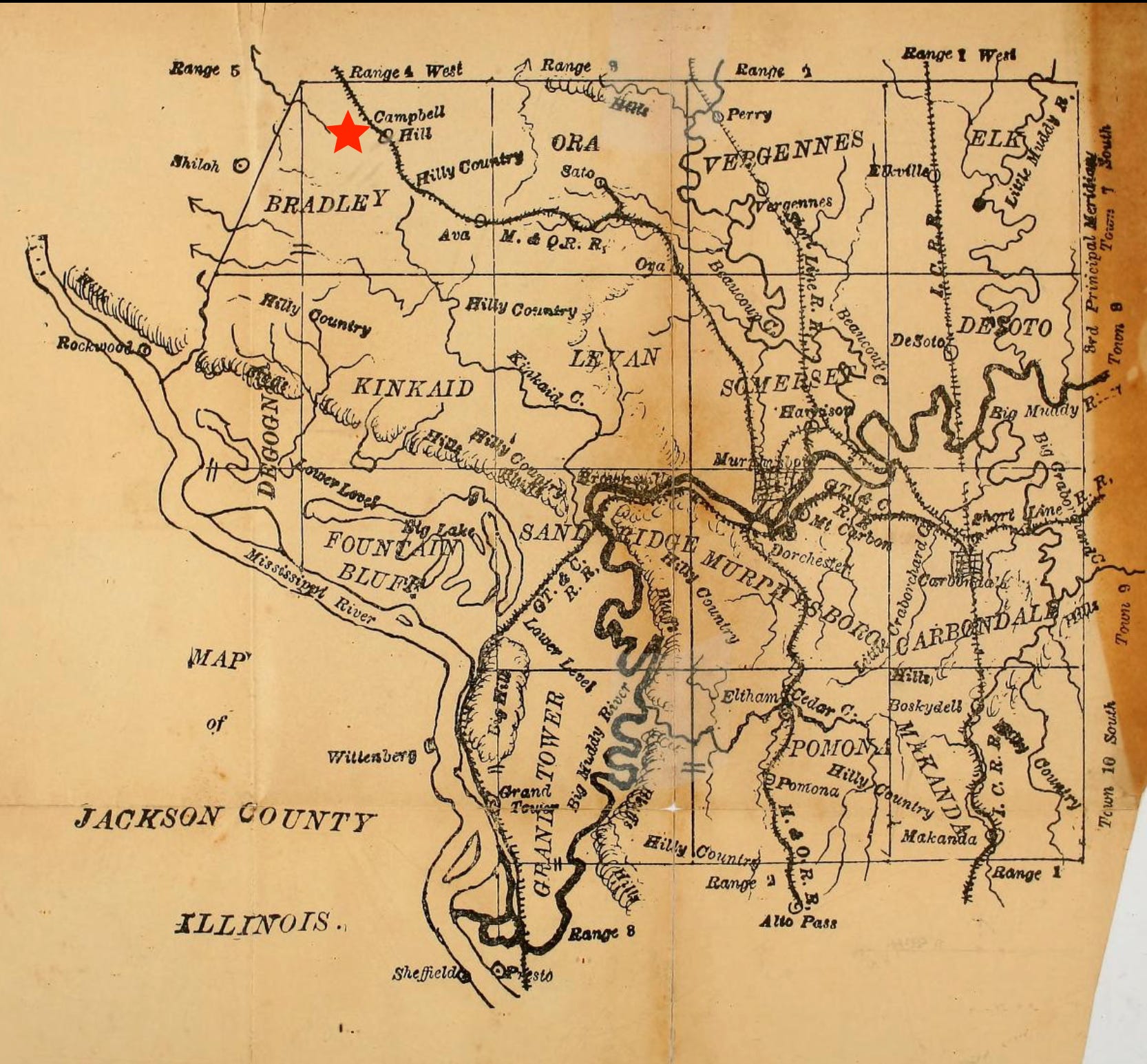
The town referred to as “C Hill” is Campbell Hill, located in the northwest portion of Jackson County, which is in southwest Illinois. Its western border runs along the Mississippi River. Campbell Hill is the small town where Sabbie and Nancy were born and grew up.
Sabray Catherine Barrow was born on October 4, 1875; her sister Nancy on November 22, 1883.1 There may have been at least one sibling who died as an infant between the sisters since the subsequent siblings, Alta and Naamon, were born just over two years apart, which was a typical interval. There were three Naamons in the family, but the postcard surely refers to the Naamon who was Sabbie’s younger brother. One of the other two was Nancy’s son who was born in 1908, the year of the postcard. The other was a half-brother of Sabbie’s father (he also had a half-sister named Sabray).
Both Sabbie and Nancy married men named Noah.
Campbell Hill is where Sabbie married Noah Underwood on May 6, 1894.2 Noah grew up in the same small town (I couldn’t resist echoing John Mellencamp here).3
The postcard was mailed in Alto Pass, which is in Union County, immediately south of Jackson. There were a couple of Underwood families living there, but I don’t know if they were any relation. Sabbie tells her sister and brother-in-law that her husband Noah is working for the railroad. Those who worked for the railroad did often move around, sometimes much longer distances.
Noah and Sabbie had three boys: Robert, Francis (Frank), and Charles. Each lived well into adulthood, although Frank sorely tested his fate at age five.
A newspaper article describes how Philip Jacob Keller, a local farmer living just outside Campbell Hill, had come into the village one morning and was standing near the Mobile & Ohio rail track enjoying a chat with friends.4 Maybe his attention was drawn by the sound of an engine or the shrill cry of the whistle, but for whatever reason, Philip glanced over to see 5-year-old Frank Underwood playing on the track, completely unaware a freight train was swiftly bearing down upon him. Philip raced to the track and was able to scoop up the child, but was clipped by the locomotive which lifted the pair off the ground and flung them to the side. Frank escaped with a deep gash on his head, but Philip suffered a broken arm, crushed ribs, and severely bruised ankles. His quick action saved Sabbie and Noah’s son from a truly awful end.
On an October evening, a group of locals visited Philip at his home where he was still recuperating and presented him with a gold watch for his bravery.5 In November, Philip was reported to have been awarded $650 in damages for his injuries.6 He would have been 63 years old at the time. It didn’t say who the damages were paid from, but quite probably it was from the M & O railroad.
It isn’t impossible he sued the Barrows for the money, but it seems less likely than receiving a settlement from the railroad. When I followed the Keller line back a generation, it turns out Philip was related by marriage to both the Barrows and the Carters. Philip’s daughter Effie had recently married Carter Aaron Barrow.
It gets tricky here. Carter was born in 1875, the same year as Sabbie, but was the half-brother of Sabbie’s father, which is to say, another son of her grandfather (who was also named James Barrow, born 1814). So Carter Barrow was Sabbie’s uncle and he was married to Philip Keller’s daughter.
The elder James’s first marriage was on November 20, 1834 to Catherine D. Crider. Catherine bore 13 of the 17 Barrow children. She died in February of 1865.
On July 13, 1865, James (the elder) remarried to Sabray Carter (who was related to Noah Carter, Nancy’s future husband). James and this Sabray had four children, the youngest being Carter Barrow, born 1875. James Salathiel Barrow, who was born in 1854 and was Sabbie’s father, was one month shy of being 19 years older than his youngest sibling.
Back to Philip Keller. His daughter, Effie, married Carter Barrow on June 18, 1899. On the 1900 census from June 6, Philip is recorded as living with Carter and Effie and is listed as a Landlord.
Carter Barrow was a farmer with the outstanding characteristic of being the tallest man in the county. Newspapers from Illinois and Tennessee reported on Carter’s height. There are a couple of photos of him online. I wasn’t easily able to determine who the owners were in order to get permission, so I am not using either of them here. Carter clearly is extraordinarily tall, though. In one of the photos, the man at Carter’s side is noted as George Wayland, who stood 6’2,” and Carter is noted as 6’ 10.” There is definitely an eight inch difference in their heights.
In a sad turn for the young couple, only eighteen months after their marriage, Carter died on Monday, December 10, 1900 of typhoid fever. His obituary mentions that a special coffin was built for him.7
Two years after the postcard, Noah and Sabbie had moved to Centralia, Illinois where Noah worked as a machinist for the railroad.8 The census records them as residents there in 1910 and 1920. Their home wasn’t far from some of my family who lived there.
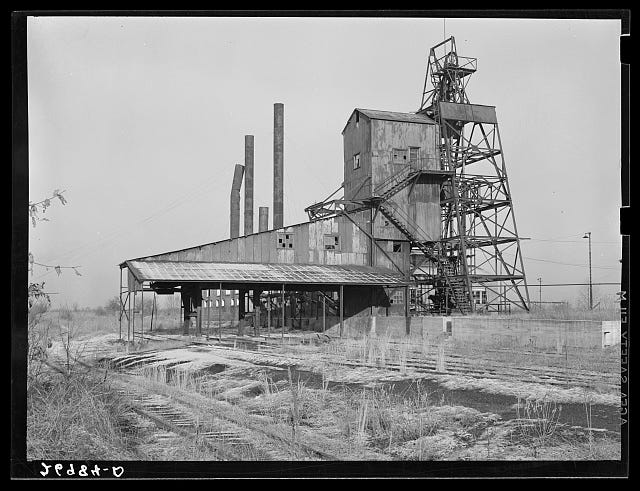
In 1920, Noah was working for the coal mine, as so many men did, including my grandfather and great-grandfather, as well as some of my husband’s family. Between 1920 and 1930, Sabbie and Noah moved to Alabama. According to a 1927 social page item from Tamaroa, Illinois, the Underwoods were in town from Alabama visiting the Carters.9 I don’t know what city they lived in there, or for how long, since this is the only documentation I have found.
By 1930, the couple were back in Illinois, living on Layman Street in Benton in Franklin County. Noah was 60 years old and was still working as a coal miner.
In 1940, Noah had retired. The couple still lived in Benton, and were renting a house at 207 Election Street. This address turned out to be important in tracing Sabbie after Noah’s death. He died of chronic nephritis on November 30, 1942 at 72 years of age.10 He is buried in the Masonic & Oddfellows Cemetery in Benton.
If it hadn’t been for the death of Sabbie’s father in 1947, I may not have known she remarried after Noah’s death. Her father’s obituary lists her among his survivors as “Mrs. Sibby Hodge of Benton.”11 I haven’t found a record of this marriage, but I was able to come to some degree of certainty that it was Alvin Hodge she married.
My best possibility was on the 1950 census. There was an Alvin and Catherine Hodge living at 413 Lawrence Street. Catherine was Sabbie’s middle name and the age was within two years. Noah Underwood and Alvin were both coal miners. The streets they lived on were within the same neighborhood in Benton. But for me, the thing that pointed to Catherine Hodge being Sabray Catherine Underwood was this.
In 1920, when Sabbie and Noah still lived in Centralia, Alvin Hodge and his first wife Nancy lived in the house at 207 Election Street. This is the same house the Underwoods were renting 20 years later in 1940. Alvin and Nancy owned the home when they lived there in 1920. I wonder if when they moved out, they kept ownership of the house to rent out for additional income. They had ten children, so it would be understandable.
Sabbie would have known Alvin Hodge for at least a few years through his owning the home she lived in. In 1940, Nancy and Alvin lived in the same Lawrence Street house in which Catherine lives in 1950. She doesn’t appear anywhere else in that census. Nancy Hodge died in 1946. Sabbie had been a widow for four years at the time. She and Alvin would have married sometime between 1946 and 1950.
That 1950 census dates the enumeration of the Hodges on April 7. Alvin Hodge died two days later on April 9, 1950. Sabbie was once again a widow. At this point, she likely moved to Lapeer, Michigan. Her youngest son, Charles, lived there, where he and his wife Dorothy worked in a bakery.
Sabbie died on June 6, 1960 and is buried in Lapeer, Michigan, and this is why I feel she had been living there. Had she still lived in Benton, I’m not sure why her family would have transported her to Michigan for burial rather than alongside Noah in Benton.
Sabbie’s sister, Nancy, died in October of 1974 at 90 at a hospital in DuQuoin, Illinois.12 Her husband Noah Carter died in 1945 at the same hospital.13 They were both still residents of Tamaroa.
Sabbie’s eldest son, Robert, was a 2nd Lieutenant in WWI. He worked as a salesman for the National Lead Company. Robert died of pulmonary emphysema on February 13, 1959 at Brooke Army Hospital at Fort Sam Houston in Texas at 63.14
Eighty-nine years after his close call with a freight train, Frank died on February 21, 1991 in Clearwater, Florida at the age of 93 (he would have been 94 in September).15 He was a resident of Largo.
The youngest Underwood son, Charles, eventually retired from the Southern Pacific Railroad and retired to Robbinsville, North Carolina where he died February 24, 1979.16

Illinois, U.S., County Marriage Records, 1800-1940; Ancestry
Illinois, U.S., County Marriage Records, 1800-1940; Ancestry
Small Town, John Mellencamp, 1985
Carbondale Free Press, August 20, 1902; page 8.
Campbell Hill Eclipse via the Carbondale Free Press, October 8, 1902; page 1.
Campbell Hill Eclipse via the Carbondale Free Press, November 26, 1902; page 3.
The Daily Herald, Columbia, Tennessee; December 12, 1900; page 4
U.S. Federal Census. Unless otherwise noted, all specific locations are taken from the census.
Tamaroa Times, Tamaroa, Illinois; December 23, 1927; page 1
Death Certificate; Franklin County, Illinois; #99; November 30, 1942
Obituary; The Daily Independent, Murphysboro, Illinois; September 9, 1947; page 2
Southern Illinoisan, Carbondale, Illinois; October 13, 1974; page 5
Perry County Advocate, Pinkneyville, Illinois; August 2, 1945; page 4.
Death certificate; Bexar County, Texas; #6502; February 13, 1959.
Tampa Bay Times, February 23, 1991; page 81.
Asheville Citizen Times, February 25, 1979, page 56.
Oh my... these posts are such a remarkable snapshot into a life at a particular time.
The postcard is likely from the 1904 St. Louis World's Fair. The divided back in use after 1902, the series # 5305 implying a very large number of cards in the series and the geographic location allowing easy train travel to ST. Louis are consistent with this theory. Also, the 1904 World Fair was likely the only venue in the area to have a reconstructed Venetian Gondola ride with the possible exception of Chicago.